Monday, February 7, 2011

Egypt, Tunisia suffered for being servile to US: Iran’s Khamenei


Tehran: Iran’s Supreme Leader of the Islamic Revolution Ayatollah Seyyed Ali Khamenei said that the main cause of the protests of the Tunisian and Egyptian nations was the humiliation they suffered due to their governments' servitude to the United States. 

Ayatollah Khamenei made the remarks at Friday prayers at the Tehran University campus, in reference to the popular protests which have recently occurred in certain Arab countries. 

During his sermon, the leader called Mubarak the "servant" of Israel and the United States. 

He told worshippers, "For 30 years, this country (Egypt) has been in the hands of someone who is not only not seeking freedom, but himself is the enemy of the quest for freedom. Not only is he not anti-Zionist, but he is the companion, colleague, confidant, and in a sense, the servant of the Zionists." 

The ex-Tunisian president Zine al Abidine Ben Ali was also linked to the US and there are reports which show he had connections with the Central Intelligence Agency, the leader added. 

However, western countries are making efforts to deflect the world's attention from the main cause of the uprisings saying they occurred due to economic problems, Khamenei stated. 

He also described the developments in the Arab world as the "echoes of the voice of the Iranian nation”. 

This is the Islamic awakening that "was always talked about at the time of the victory of the great Islamic Revolution of Iran”, he added.

Sunday, February 6, 2011

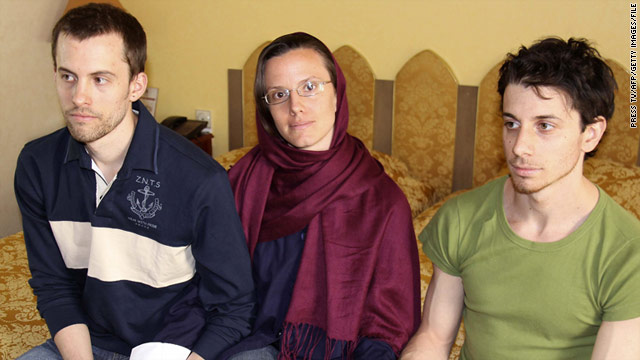
U.S. hikers to stand trial Sunday in Iran

U.S. hikers Shane Bauer, left, Sarah Shourd and Josh Fattal will be tried in Iran on Sunday for spying and trespassing. Shourd was released on bail in September and will be tried in absentia.


(CNN) -- The lawyer representing two U.S. hikers jailed in Iran has been denied a request to visit his clients on the eve of their trial, he told CNN on Saturday.

"I asked to see them before the trial, but the judge told me I couldn't," said Masoud Shafii.
The judge has granted Shafii permission to visit Shane Bauer and Josh Fattal for a few hours on Sunday prior to the start of the trial, Shafii said.

Bauer and Fattal, both 28, and Sarah Shourd, 32, were detained July 31, 2009, after they allegedly strayed across an unmarked border into Iran while hiking in Iraq's Kurdistan region. Prosecutors in Iran have charged them with spying and trespassing.

Human rights groups have condemned their arrests and their lengthy wait for a trial in Tehran's notorious Evin prison.

Last September, Iranian authorities released Shourd on bail because of a medical condition. Shourd has not responded to a court summons this week to return and stand trial on Sunday, Shafii said.

Iranian authorities said she will be tried in absentia if she doesn't appear in court.

Shafii told CNN he has reviewed his clients' case file and doesn't see any evidence of a crime.

"In my opinion, they haven't done anything wrong," Shafii said. "The accusation of spying is baseless, and if they trespassed into Iran, it wasn't their fault."

Shafii said the border area where the hikers are accused of trespassing is unmarked and anyone could unwittingly cross over into Iran.

Source: CNN NEWS

Saturday, February 5, 2011

Why are reporters being attacked?

(CNN) -- Attacks against journalists send a message.


"It clearly conveys that the government is not in favor of democratic reforms because journalists represent free speech, and free speech is crucial to democracy," said Kelly McBride, a media ethics teacher at the Poynter Institute, a U.S.-based professional journalism training center and think tank.

"The point of silencing a journalist is to pull the curtain over what's happening," she said. "The other reason is to create fear, to intimidate other reporters."

Journalists from Egypt, Great Britain, the United States, India, Australia, Greece and other countries have reported being jumped, beaten, detained and interrogated this week while reporting on the uprising against Egyptian President Hosni Mubarak.

At least one Swedish journalist was reportedly stabbed. One was marched back to her hotel at gunpoint. Many said their cameras and other equipment were smashed. A few are reportedly unaccounted for. First-hand accounts of the crackdown are lighting up Twitter. One of two correspondents from Canada's Globe and Mail newspaper tweeted a chilling timeline leading up to their apparent detainment.

In a one-day span, attacks on reporters included 30 detentions, 26 assaults and eight instances of equipment seized, and plainclothes and uniformed agents reportedly entered at least two hotels where international journalists were staying to confiscate media equipment, said the Committee to Protect Journalists, a New York-based organization, on Thursday.

"Mubarak forces have attacked the very breadth of global journalism: Their targets have included Egyptians and other Arab journalists, Russian and U.S. reporters, Europeans and South Americans," CPJ said in a news release.

The Egyptian government has publicly criticized the violence and denied involvement, but on Thursday, Vice President Omar Suleiman said international TV reporters are part of the problem.

"I actually blame certain friendly nations who have television channels, they're not friendly at all, who have intensified the youth against the nation and the state," Suleiman said in a TV address.

"They have filled in the minds of the youth with wrongdoings, with allegations and this is unacceptable. ... They should have never done that. They should have never sent this enemy spirit."

The attacks and harassment of journalists seem to be part of an organized effort, said State Department spokesman Philip J. Crowley. In a tweet early Thursday, he said: "There is a concerted campaign to intimidate international journalists in Cairo and interfere with their reporting. We condemn such actions."

State Department officials told CNN they have information that Egypt's Interior Ministry was behind the journalist detentions, citing reports from the U.S. Embassy in Egypt.

But in an interview with CNN, Crowley stopped short of naming the people behind the violence and harassment. "I can't tell you who is directing it but with the increasing number of instances of people roughing up journalist(s), cars attacked, offices broken into, journalists detained, these do not seem to be random events," he said.

Crowley suggested the attackers' endgame is intimidation, to make reporters afraid to file stories about an anticipated increase in anti-Mubarak protesters likely to take to the streets this weekend.

The violence toward journalists in Egypt seems more brazen and systematic than in any recent conflict, said Mohamed Abdel Dayem of the CPJ. Since 1981, it has tracked attacks and deaths of reporters targeted for doing their jobs. The only conflict in recent times that compares to the current situation, Dayem said, is the Algerian civil war in the 1990s.

The high number of attacks in Egypt might be, in part, because there were already a large number of reporters working in Cairo bureaus before the protests against Mubarak began, McBride said. News organizations, at least until recently, considered Cairo a convenient and friendly base from which to travel to more hostile areas in Africa and the Middle East.

Of course, that doesn't lessen outrage right now about the way reporters are being treated. But will it matter a week from now, a month from now? Will it affect the outcome of the movement to democratize Egypt?

"It's such a fast-moving story, it's impossible to know the answer now," 

said Barbara Cochran, a journalism professor at the University of Missouri School of Journalism. She was a vice president for news for National Public Radio and an executive producer of NBC's "Meet the Press."

She's covered several violent uprisings throughout her career, including China's Tiananmen Square protests in 1989.

"This is not like any other face-off between a regime that refuses to leave power and a people refusing to back down," she said.

"How it's covered, whether journalists will feel secure enough to cover it, will matter."

Newer technology -- the Web, Twitter, Facebook, smaller and cheaper recording devices such as Flip Cams -- has liberated reporting in many ways, Cochran said. But it also made journalists easier targets.

"When I was working, you could get into a country, do the reporting and get out without anyone sending a tweet out about your presence," she said. "And there wasn't a huge rush to report immediately, as there is now with news agencies competing to be the first to report online what's happening."

The story in Egypt is also unique because the Egyptian government managed to shut off access to the internet, blocking information that bloggers might have provided.

Consider that without Twitter or other social media tools, 2009's popular protests against Iranian President Mahmoud Ahmadinejad over contested election results would have been largely underreported, McBride and Cochran said.

Foreign journalists were blocked from entering the country. Ultimately, Ahmadinejad remained in power.

"I thought Iran would (be the country) in my mind that hit rock bottom (in how it treated reporters), but what Mubarak is doing is unspeakable," said Dayem.

In denying that the Egyptian government is behind the violence, Mubarak told ABC News on Thursday that the Muslim Brotherhood is to blame.

But there are other regions where sustained violence toward journalists has been raging for years, and little change has come of it. In Mexico, for instance, cartel violence continues despite the disappearance or death of more than 30 reporters since 2006, CPJ reported.

Egypt, perhaps, seems different to Western audiences, said McBride.

"Cairo resonates with us. It's an ally, tourism is big there. Most people considered it safe. I think part of why this story has captivated an audience is because they are saying, 'This is not the Egypt I thought I knew.' "

SOURCE: Ashley Fantz, CNN NEWS

Friday, February 4, 2011

Protesters hit Yemeni streets, despite concession from president


Sanaa,Yemen (CNN) -- What seemed like thousands of anti-government protesters gathered near Sanaa University in Yemen's capital early Thursday morning, a clear indication that many in the country were not satisfied with President Ali Abdullah Saleh's recent announcement that he would not seek re-election.

Protesters of all ages chanted and held signs with messages against poverty and the government. Some proclaimed that Saleh needed to step down.

As the protest quickly grew, there was very little visible security in the area.
About a kilometer away from the anti-government protest, a large crowd of government supporters gathered for a counter demonstration.

Many in that crowd expressed support for Saleh and said he was doing a good job as president.

There were no apparent clashes between the two sides or with security forces.

Later in the day, in an apparent critique of his detractors, Saleh told members of his defense council that he wanted to "thank the Yemeni people who stayed calm despite wrong mobilization over the last months that resulted in social unrest in the Yemeni street," according to a report from the state-run SABA news service.

He called out the anti-government demonstrators for going ahead with their march Thursday despite his concession a day earlier.

"None reacted positively and parties continued to rallies and protests at a time when the public is nervous," Saleh said, according to SABA. The president added that he watched the demonstrations Thursday on TV.

Trying to quell a growing discontent in the country, Saleh said he will not seek re-election once his current term ends in 2013, after more than three decades in office. Saleh has been in office for 32 years and was last re-elected in 2006.

He won't install his son to replace him, he said. He also has asked his political opponents "to re-engage in dialogue in hopes of reaching a sustainable and reconcilable political agreement," the Yemeni government said.

"I have a big hope the political forces will respond to the initiative and take it seriously," Saleh said Thursday. "All should show interest in dismissing tensions and agitation because dialogue is the best way to address all issues."

Thursday's protest came amidst similar ongoing unrest in Egypt and a revolt in Tunisia that forced that nation's longtime strongman to flee to Saudi Arabia in mid-January.

King Abdullah of Jordan, meanwhile, has sacked his government and appointed a new prime minister in the face of protests there.

The protests -- which have also caught on to various extents in Algeria and Sudan -- have proved to be "a real watershed event for the Arab world," said Blake Hounshell, managing editor of Foreign Policy magazine. "It's really unprecedented."

SOURCE: CNN's Mohammed Jamjoom contributed to this report.

Thursday, February 3, 2011

The Danger Safari - ???


Wouldn't it be scary, if a lion jumped on the bonnet of your car, just several centimeters away of you?

These folks don't seem frightened.


This is the Werribee Open Range Zoo in Victoria, Australia and only the bonnet of the car is inside the glass cage with lions.The rest of the car is on the outside. Very interesting way of interacting with the lions. Interesting ???

Wednesday, February 2, 2011

Jordan's king fires Cabinet amid protests

By JAMAL HALABY, Associated Press

AMMAN, Jordan – Jordan's King Abdullah II fired his government Tuesday in the wake of street protests and asked an ex-prime minister to form a new Cabinet, ordering him to launch immediate political reforms.

The dismissal follows several large protests across Jordan_ inspired by similar demonstrations in Tunisia and Egypt — calling for the resignation of Prime Minister Samir Rifai, who is blamed for a rise in fuel and food prices and slowed political reforms.

A Royal Palace statement said Abdullah accepted Rifai's resignation tendered earlier Tuesday.

The king named Marouf al-Bakhit as his prime minister-designate, instructing him to "undertake quick and tangible steps for real political reforms, which reflect our vision for comprehensive modernization and development in Jordan," the palace statement said.

Al-Bakhit previously served as Jordan's premier from 2005-2007.

The king also stressed that economic reform was a "necessity to provide a better life for our people, but we won't be able to attain that without real political reforms, which must increase popular participation in the decision-making."

He asked al-Bakhit for a "comprehensive assessment ... to correct the mistakes of the past." He did not elaborate. The statement said Abdullah also demanded an "immediate revision" of laws governing politics and public freedoms.

When he ascended to the throne in 1999, King Abdullah vowed to press ahead with political reforms initiated by his late father, King Hussein. Those reforms paved the way for the first parliamentary election in 1989 after a 22-year gap, the revival of a multiparty system and the suspension of martial law in effect since the 1948 Arab-Israeli war.

But little has been done since. Although laws were enacted to ensure greater press freedom, journalists are still prosecuted for expressing their opinion or for comments considered slanderous of the king and the royal family.

Some gains been made in women's rights, but many say they have not gone far enough. Abdullah has pressed for stiffer penalties for perpetrators of "honor killings," but courts often hand down lenient sentences.

Still, Jordan's human rights record is generally considered a notch above that of Tunisia and Egypt. Although some critics of the king are prosecuted, they frequently are pardoned and some are even rewarded with government posts.

It was not immediately clear when al-Bakhit will name his Cabinet.

Al-Bakhit is a moderate politician, who served as Jordan's ambassador to Israel earlier this decade.

He holds similar views to Abdullah in keeping close ties with Israel under a peace treaty signed in 1994 and strong relations with the United States, Jordan's largest aid donor and longtime ally.

In 2005, Abdullah named al-Bakhit as his prime minister days after a triple bombing on Amman hotels claimed by the al-Qaida in Iraq leader, Jordanian-born Abu Musab al-Zarqawi.

During his 2005-2007 tenure, al-Bakhit — an ex-army major general and top intelligence adviser — was credited with maintaining security and stability following the attack, which killed 60 people and labeled as the worst in Jordan's modern history.

source: Asociated Press

Tuesday, February 1, 2011

Machetes, meat cleavers, axes: Cairo's new neighborhood watches

Unrest in Cairo, Egypt, has forced neighborhoods to provide for their own security.


Editor's note: CNN's Arwa Damon has reported from the front lines of the wars in Iraq and Afghanistan. Here, she describes the street scenes of Cairo.

Cairo, Egypt (CNN) -- As curfew kicks in, young men carry sticks, swords, machetes, meat cleavers, axes -- anything they can find to arm themselves.
They come out en masse, set up makeshift checkpoints and guard access to their neighborhoods.

Children carry knives longer than their forearms. The kids wave down cars and peer in warily. They are among the youngest members of neighborhood watch groups that have sprung up across Cairo.

With their country teetering on the brink of the unknown, these residents have taken security into their own hands. Many haven't slept in days. The official police force is nowhere to be seen, say many witnesses.

One of the main roads through the capital -- Pyramid Road leading to one of Egypt's most historic sites -- resembles a battlefield rather than the popular food and shopping stop known to Egyptians and tourists. Windows are broken, awnings hang in tatters, stores that survived the various rampages remain shut, their windows white-washed or covered in newspaper.

This is not the capital that millions across the world would recognize; nor is it one that many residents want the outside world to see.

While the demonstrations at Tahrir Square speak to an era of change, the rest of Cairo speaks to the broader repercussions of demanding that change. Lines extend at popular bread factories amid fears of a food shortage.

As CNN films from a bridge nearby, people standing in line gesture for us to stop. A child picks up a rock.

"Why are you filming this?" a man shouts. "Is this a nice image? It's ugly!"

He threatens to break our camera.
Watch lawlessness in Cairo

That same anger and frustration is felt throughout the city, especially toward the news media. The rage has intensified among those away from the demonstrations -- some say the news media is showing distorted images of Egypt.

In the chaos at another bread line, a woman says Egyptians want President Hosni Mubarak to stay. The men there angrily demand that CNN leave, saying they don't want to be filmed in this sort of a desperate situation.

The same woman we met then comes to our car and apologizes for the way we are treated.

"It's only because of the terrible situation that we are in," she says, referring not just to the uncertainty but also to the struggle that daily life has become.

"We are good people. We are sorry."

It's not just the food shortages that are of rising concern. Most of the gas stations on major roads in the heart of the capital are closed. One owner, who did not want to appear on camera or have his station filmed, said it was because of security. He then ordered us to leave.

Scenes across Cairo
Another gas station had simply run out of fuel and was hoping that a tanker would appear. It doesn't seem likely.

Banks are all closed; the screens on ATM machines blank.

At one middle-class neighborhood, a woman in a black abaya demands to see our press credentials. A crowd gathers, shouting.

Muna al-Mahdi is the only person willing to air her grievances on camera.

"I am upset with the revolution in Tahrir Square," she says, her voice trembling with emotion. "It doesn't represent us. It doesn't represent our opinion. We are here sticking with Hosni Mubarak only.

"Give him two months, give him time to work," she says. "And then he can go peacefully."
Her voice quivers even more as she switches to Arabic to ask, "Who is going to govern Egypt? A bunch of youth?"

Another woman shouts: "I don't agree with you. You're not giving the right impression."

As the two women argue, a man in the crowd pushes his hand against the camera.

"Stop filming," he says.

Tensions rise. I head head back to the car with the rest of the CNN crew. Just as we're about to leave, a group of men -- headed by one wielding a machete -- stops the car in the parking lot.

The man screams to know what and why we are filming. He demands the tape, threatens to drive his machete into the hood of the vehicle. Eventually, we are able to leave peacefully.

It's another sign of the unknown.
Yet however much the winds of change are threatening to tear this nation apart, the demonstrators are determined to weather it.

"People here are supporting each other, you know. My neighbor gave us food, gave us water and all that we need. All the stores are supporting the people," Barak Saleh says as he heads back to the demonstration ground.

A group of young men carry a yellow sign painted in red. "Game over," it reads.

Overhead, a kite flutters in the wind.


source: CNN NEWS

Sponsor Links

LEARN PHOTOSHOP IN JUST 2 HOURS!
Do You Want To Know The Fastest Way To Master The Basics Of Adobe Photoshop!
Very Well Conceived And Presented Of All The Tutorials!
www.learnphotoshopnow.com

MOBILE SPY SOFTWARE!
Track EVERY Move Your Partner, Employee or Child is Making Using Our POWERFUL Cell-Phone Monitoring Technology!
www.spybubble.com

TEACH ENGLISH ONLINE AND GET MONEY!
Have A Very Profitable Stay At Home Business Teaching English On The Internet!
Money Into Your PayPal Account Every Month!
iteachenglishonline.comt